
Life as a Christian
- Sebastian Harris
- Sep 18, 2025
- 3 min read

Updated: Oct 29, 2025
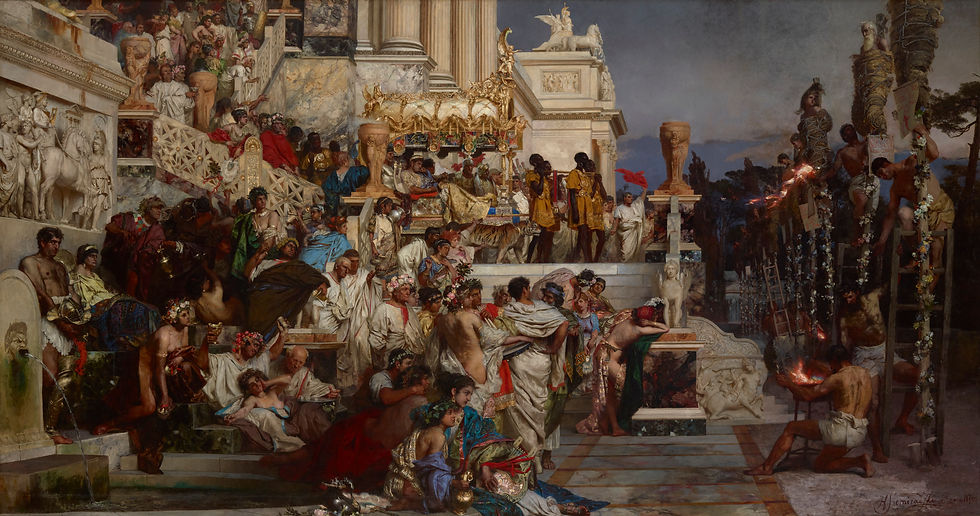
Life was not easy for Christians, as the tomb of an unidentified Alexander suggests: “he has scarcely lived, who has lived in Christian times” [1]. Whilst already worried about violent persecutions, their beliefs were also criticised and ‘dragged through the mud.’ Although evidence suggests “Roman authorities generally tolerated Christians,” they were commonly accused of many things, including atheism, infant cannibalism, incestuous relationships and magician worship, but worst of all was mind corruption [2]. In fact, there was a Hospitium Christianorum (“Hotel of Christians”) in Pompeii, with graffiti stating that an individual (Bovios) was “hearing the savage Christian horrors,” which depicted Christians in a bad light, likely added during Nero’s Persecution [3]. This was a shared sentiment among the common people.

Christianos Graffito (Hotel of the Christians, Pompeii) [c. AD 64-79]
More blasphemous was the accusation of worshipping an ass-headed god, which emerged from Tacitus’ record of Moses following donkeys to find water in the desert or the placement of an ass head in the Jewish Temple [4]. There is archaeological evidence of this belief in the same Hotel of Christians where someone wrote “this mule (Jesus), to the little flies (apostles), liar salutes truth everywhere” [5]. In the third century, the Alexamenos Graffito in the Palatine Museum depicts Jesus with an ass’s head and the inscription “Alexamenos worships his God” [6]. As the Christian apologist Athenagoras wrote, these accusations were “idle tales and empty slanders,” and reflective of the “wholesale charges… of the idle Praters themselves” [7].

Alexamenos Graffito (Palatine Museum, Rome) [c. AD 200]
But how did Christians actually see themselves? Beneath Rome, there are kilometres of catacombs belonging to Christians of different backgrounds from several centuries, and each tombstone revealed a contrary view that Christians honour each other, demonstrating the strength of the Christian creed. Christianity was first intertwined with Roman religion, as the Epitaph of Licinia Amias reveals. The fish represented an early hidden Christian “fish” phrase, IΧΘΥC (Iesus Christ, God's son, Saviour), that Christians would recognise, but included distinctly Roman elements, including the wreath and DM (“to the departed spirit”) [8]. Furthermore, the Christian faith was not limited by race or class. Due to the fast-spreading nature of Christianity, especially in the provinces and into the third century, the religion became very popular with the Roman army and families [9].


Comments